Cotton Props
Full IntelliSense, validation, and tooling for Django Cotton components in VS Code — autocomplete, hover docs, 19 diagnostic rules, quick fixes, and a component explorer. Stop guessing prop names and catch template mistakes before they hit the runtime.
See it in action
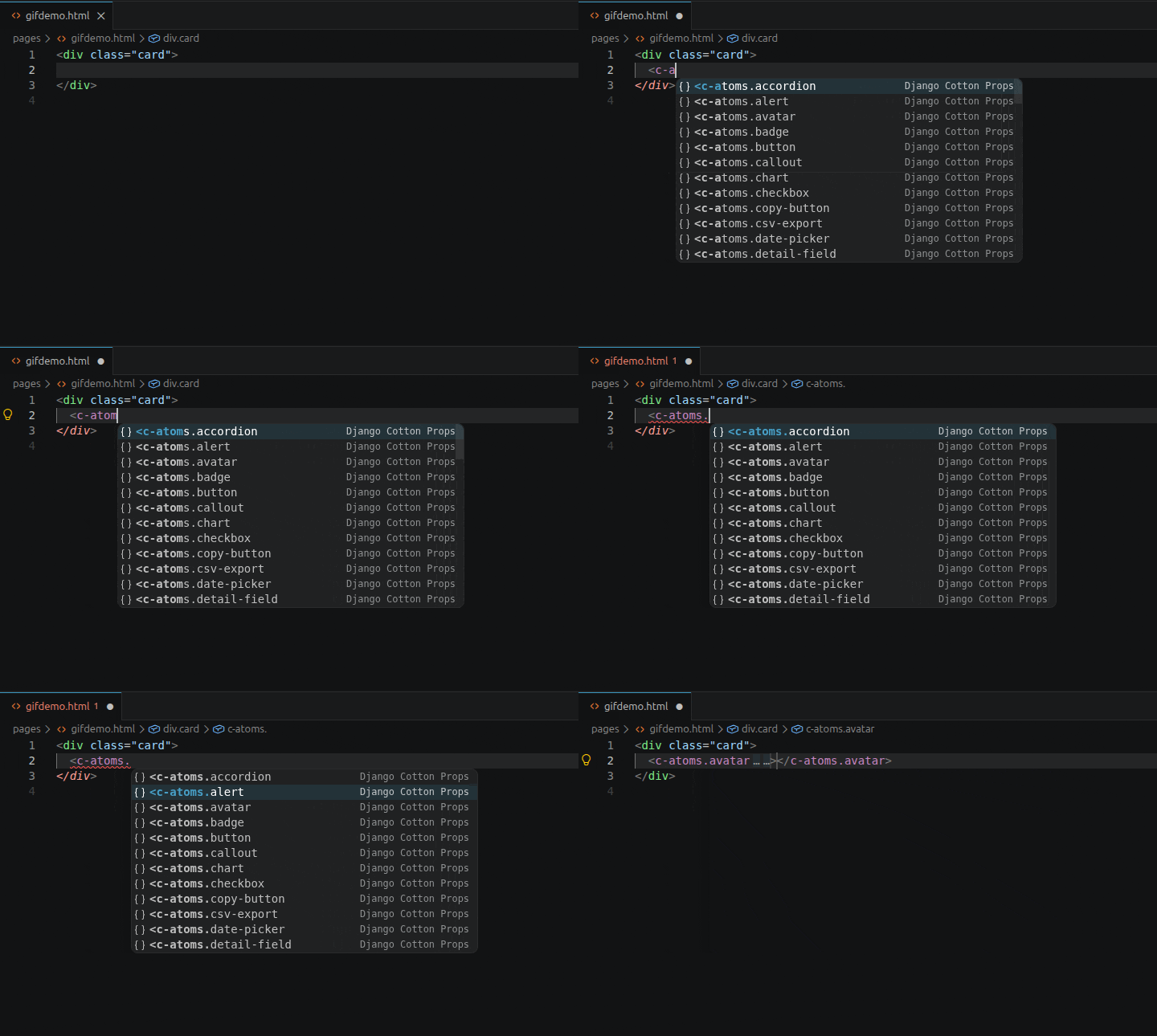
Autocomplete every component, navigate, and accept — without leaving the keyboard
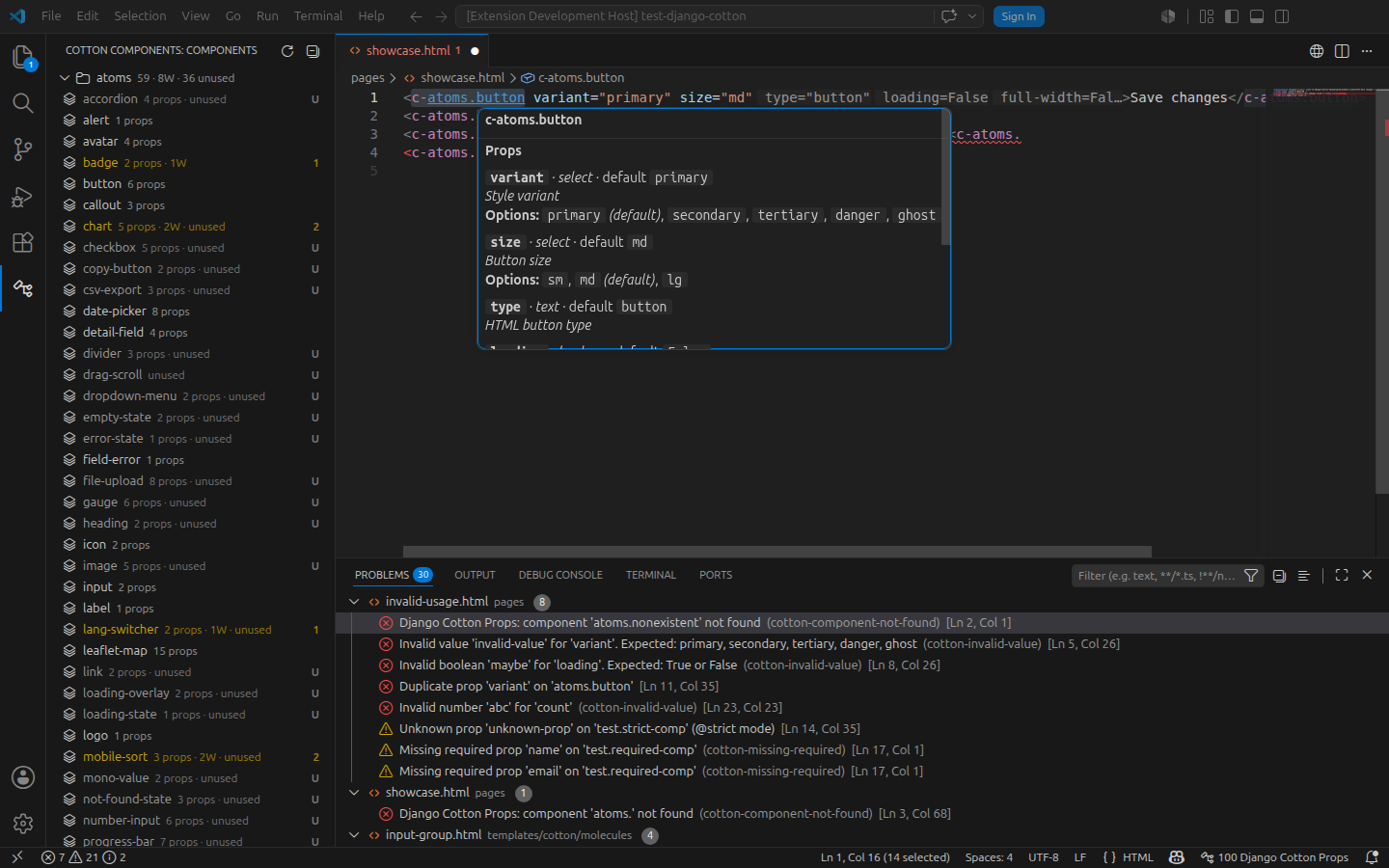
Hover any tag for its full prop documentation
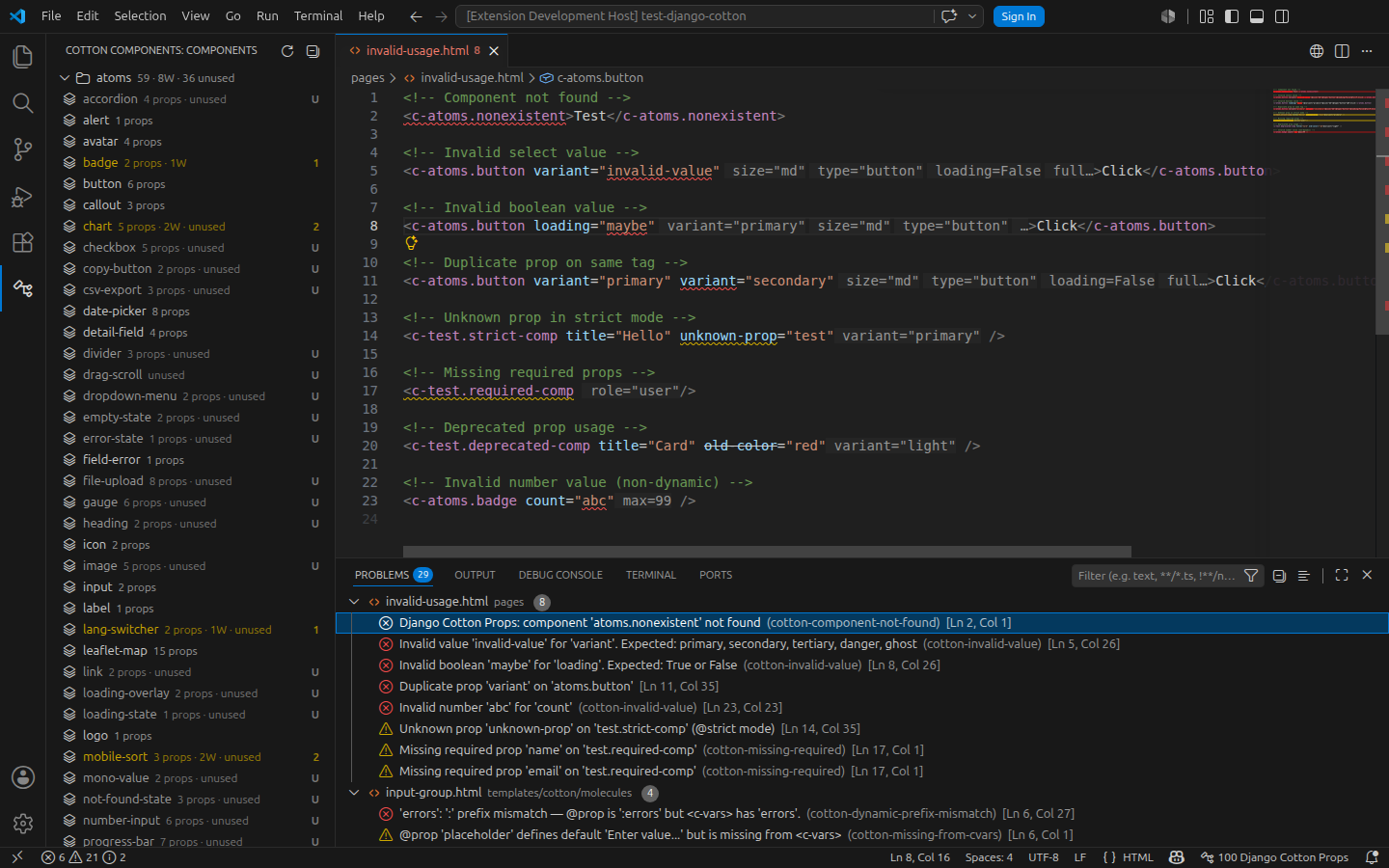
Catch mistakes as you type — 19 diagnostic rules
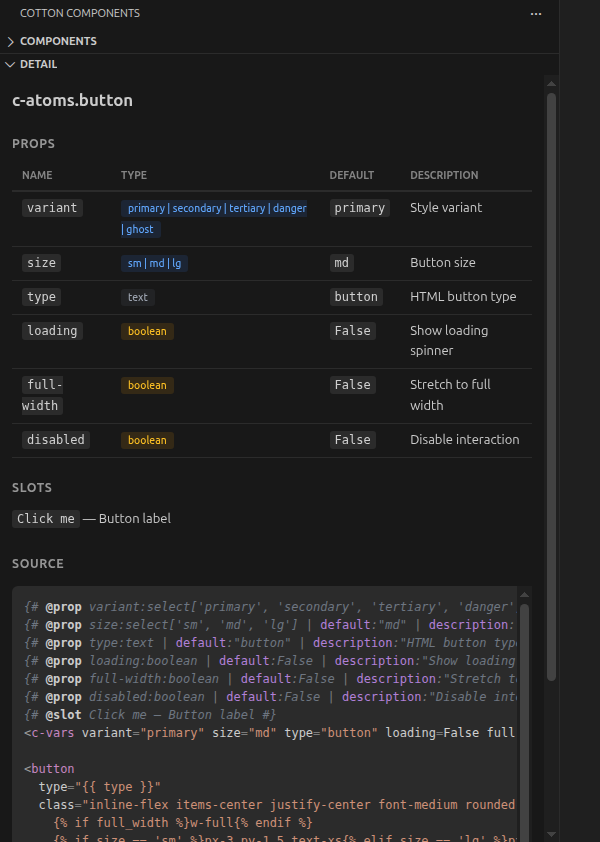
Select any component to inspect its props, slots, and highlighted source — in the sidebar
Getting started
- Install — search Cotton Props in the Extensions view, or run
ext install velezanthony.cotton-props. - Requirements — a Django Cotton project with component templates, and VS Code 1.97+. The default
templates/cotton/layout needs zero configuration. - Go — open any
.htmlordjango-htmltemplate, type<c-, and autocomplete, hover docs, and diagnostics light up instantly.
Features
Everything works in .html and django-html files, live as you type.
| ⚡ Autocomplete | tags, props, and values — grouped by category, with type / default / required / deprecated badges |
| 💡 Hover docs | description, prop table, slots, and trigger HTML on any tag or prop |
| 🧭 Navigation | Go to Definition (F12), Find All References, Outline symbols, Rename Prop (F2) |
| 🔀 Dynamic dispatch | understands <c-component is="..."> in all three forms |
| 🚦 Diagnostics | 19 edit-time rules across component and usage files |
| 🛠️ Quick fixes | one-click document / sync / insert actions on the 9 auto-repairable diagnostics |
| 🔁 Auto-rename tag | the closing tag follows the opening tag as you edit, through nesting |
| 🗂️ Sidebar explorer | component tree, detail panel, and drag-and-drop usage blocks |
| 🎁 Refactors | Wrap with Component, Extract to Component, convert direct ↔ dispatch |
| 🎨 Editor aids | semantic highlighting, inlay hints, code lens, folding, signature help, status-bar count |
| 📁 Safe renames | renaming a component file updates every <c-tag> reference project-wide |
🚦 All 19 diagnostic rules — what gets flagged at edit time
**In component files:** - Duplicate `@prop` definitions - `@prop` missing from `🛠️ Every quick fix — one click on the lightbulb
- **Document prop** / **Document all props** — generate `@prop` annotations with guessed types - **Add required prop** / **Add all required props** — insert missing required props with defaults - **Add to `🔀 Dynamic tag dispatch — the three forms of <c-component is="...">
Cotton's built-in dispatcher renders a component whose name is decided at runtime. The extension understands all three shapes:
| Syntax | Treatment |
|--------|-----------|
| `🗂️ Sidebar explorer — tree, badges, detail panel, drag & drop
The activity-bar icon opens the **Cotton Components** panel: - **Components tree** — collapsible categories with aggregated diagnostic counts: `atoms 59 · 4E 2W 8H · 12 unused` - **Per-component badges** — a single count for the highest severity present (capped at `9+`), coloured by that severity; a `U` badge when a component has no diagnostics and is referenced nowhere. The row text spells the full breakdown out: `3 props · 2E 1W 8H · unused` - **Detail panel** — click a component for its props table, slots, and syntax-highlighted source - **Drag & drop** — drag a component into the editor to insert a full usage block with every prop as a tabstop and defaults pre-filled; `Tab` steps through them - **Tag filter** — the title-bar button opens a filter box and the tree narrows as you type, matching a case-insensitive substring against the full dotted tag (so both `atoms` and `button` reach `atoms.button`). The active filter shows as `Filter: …` in the view header and survives closing the box; clear it with the title-bar button, by emptying the box, or with `Escape` while the tree has focus - **Copy tag** and in-tree **search** (`Ctrl+F`)🎨 Semantic highlighting — @prop annotation colors (theme-aware)
| Token | Example | Color |
|-------|---------|-------|
| Delimiters | `{#` `#}` `\|` | comment (green/gray) |
| Keywords | `@prop` | keyword (purple) |
| Prop name | `variant` | variable (blue) |
| Filter names | `default` `description` | variable (blue) |
| Values | `"primary"` `13` `False` | string (orange) |
| Component tags | `c-atoms.button` | keyword (purple) |
Colors adapt to your active VS Code theme.
Reference
The full catalogue lives in docs/REFERENCE.md:
- Prop annotation syntax — every
@propfilter, the<c-vars>contract, and how the two stay in sync - Diagnostic rules — one section per code, with the smallest input that triggers it
- Settings — every
djangoCottonProps.*option
Troubleshooting
Components not showing up?
- **No completions, or the sidebar is empty?** The extension scans `templates/cotton/` by default. If your components live elsewhere, add the folder to `djangoCottonProps.templatePaths` — path suffixes matched at any depth, so one entry covers the project root and every Django app. Changes apply live, no reload. - **A component is flagged `unused` but it isn't?** It's reached only through a dynamic `Built for Django Cotton · MIT licensed · Requires VS Code 1.97+